Engine Model Accuracy
-
Hi Nick,
Thanks for the response. The Caravans I'm referring to are stock standard PT6A-114A engines with no STC. I understand the way you setup the parameters from the POH. When setting Max Cruise power settings on the Caravan, we check the POH Tables to get a Torque Value for Max Cruise and set that Torque setting. In doing so we also check to not exceed the Max Cruise Torque of 740 ITT, which it should never get close to. Same with the NG%, which seem normal on your engine simulation. If you ITT sits at the Max Cruise ITT of 740 that usually means you may have damage to the engine or an unhealthy engine (which is why I immediately checked engine health on the tablet ).
).
To some extent the same applies to Take-Off and Climb, probably harder to pinpoint on the sim as data for take-off varies depending on airport altitude and temperature. You should be easily be able to achieve Max Take-Off torque, without being too close to Max ITT (805) or Max NG (101.6), so for example at Sea-Level 10 degrees, the Max Torque is at the ceiling of 1865 Torque, your ITT should be lower than 805 and NG below 101.6
I can try get some Cruise data from our Engine Trend Monitoring system and email it to you.Just to summarize, when you set Max Cruise Torque, the closer your ITT is to 740, the more unhealthy you engine is.
@asnamara Thanks again, as all of this is good data. I apologize again for my questioning, but I like to have as good of an understanding of this as possible, since it might have implications for all my PT6 aircraft. Several of the other PT6 POH's I've used contain the language "all figures at... [ITT or TQ limit]", while I see the Caravan's says, "Do not exceed... [ITT or TQ limit]" My question is, do we know why these torque values were determined to be the "maximum" by the engineers, if not due to the ITT limit?
-
No problems, ask as many questions as you'd like. I think this may apply only to the Caravan, as the Max Cruise Torque was put in place to improve engine life, and appropriate for the mission the Caravan is meant to carry out.. Its a flat-rated setting established by Cessna. So a slightly different philosophy than other aircraft types with PT6.
When I use to fly the King Air, we set Cruise Power based on Max ITT. So your Turbine Duke should be fine by using ITT for cruise, and your modeling for that aircraft should be correct as well.
For another comparison, I also fly the Caravan EX with a PT6A-140 engine, which also has a Max Cruise Torque.. Its maximum cruise ITT is 805, but at Max Cruise Torque we get around 740-750 on the ITT.
Hope that makes sense? -
No problems, ask as many questions as you'd like. I think this may apply only to the Caravan, as the Max Cruise Torque was put in place to improve engine life, and appropriate for the mission the Caravan is meant to carry out.. Its a flat-rated setting established by Cessna. So a slightly different philosophy than other aircraft types with PT6.
When I use to fly the King Air, we set Cruise Power based on Max ITT. So your Turbine Duke should be fine by using ITT for cruise, and your modeling for that aircraft should be correct as well.
For another comparison, I also fly the Caravan EX with a PT6A-140 engine, which also has a Max Cruise Torque.. Its maximum cruise ITT is 805, but at Max Cruise Torque we get around 740-750 on the ITT.
Hope that makes sense?@asnamara That's exactly the kind of information I was looking for! I will check with some other Caravan pilots and see what they say about this. It would make sense, as to why I haven't heard about something like this before, as well. This should be an easy change, as well, since it would just mean scaling the ITT value by a constant factor from my current values. Thanks again for chiming in, and anything else you have to share is more than welcome!
-
B Black Square referenced this topic on
-
As a pilot, and after a few hours of flying in the Caravan, I found the sound perfect, everything is almost perfect. Taking advantage of the engine topic, in the real Caravan, if you use 500 lbs-trq, it can't maintain 100 knots level, even with the aircraft less full. It felt like it was a bit overpowered. Another observation I made is that in the real one, when you reduce the throttle to idle, it rapidly drains the speed. Sometimes I come in at VMO up to 2 nautical miles from the runway threshold and reduce to idle, the aircraft's speed drains rapidly, full flaps, and I still need to increase the engine power to avoid stalling. I didn't feel this braking in flight as happens with the real aircraft. This is a suggestion for improvement, it would be greatly appreciated, especially by real pilots. I'm happy to have invested money! Congratulations on the aircraft, it's almost perfect.
-
@asnamara That's exactly the kind of information I was looking for! I will check with some other Caravan pilots and see what they say about this. It would make sense, as to why I haven't heard about something like this before, as well. This should be an easy change, as well, since it would just mean scaling the ITT value by a constant factor from my current values. Thanks again for chiming in, and anything else you have to share is more than welcome!
@Black-Square Hi Nick, After flying your aircraft for a couple of longer flights, I'm happy to say your fuel burn is spot on! Basically on 5+ hour flights, you're within pounds of the fuel consumption of the actual aircraft. The tablet usually predicts a lower endurance, but at max cruise power FL100 to FL120.. you've got the burn spot on. Awesome!
-
So the real-life Caravan pilots agree that the 208 shouldn't be ITT-limited down low? I’m used to the TBM, which is always torque-limited down low and doesn’t become ITT-limited until you get up into the flight levels where the air is really thin.
-
As a pilot, and after a few hours of flying in the Caravan, I found the sound perfect, everything is almost perfect. Taking advantage of the engine topic, in the real Caravan, if you use 500 lbs-trq, it can't maintain 100 knots level, even with the aircraft less full. It felt like it was a bit overpowered. Another observation I made is that in the real one, when you reduce the throttle to idle, it rapidly drains the speed. Sometimes I come in at VMO up to 2 nautical miles from the runway threshold and reduce to idle, the aircraft's speed drains rapidly, full flaps, and I still need to increase the engine power to avoid stalling. I didn't feel this braking in flight as happens with the real aircraft. This is a suggestion for improvement, it would be greatly appreciated, especially by real pilots. I'm happy to have invested money! Congratulations on the aircraft, it's almost perfect.
-
You come in at Vmo on a two mile final? Curious, what's the difference between Vne and Vmo?
@Buzz said in Engine Model Accuracy:
You come in at Vmo on a two mile final? Curious, what's the difference between Vne and Vmo?
VNE - Never Exced.
VMO - Maximum Operation Speed.Sometimes I came with 175kts on final, 2 miles and when I reduce the throttle, the speeds drain. Lower the flaps and I get 90-85kts to land.
-
@Buzz said in Engine Model Accuracy:
You come in at Vmo on a two mile final? Curious, what's the difference between Vne and Vmo?
VNE - Never Exced.
VMO - Maximum Operation Speed.Sometimes I came with 175kts on final, 2 miles and when I reduce the throttle, the speeds drain. Lower the flaps and I get 90-85kts to land.
-
No problems, ask as many questions as you'd like. I think this may apply only to the Caravan, as the Max Cruise Torque was put in place to improve engine life, and appropriate for the mission the Caravan is meant to carry out.. Its a flat-rated setting established by Cessna. So a slightly different philosophy than other aircraft types with PT6.
When I use to fly the King Air, we set Cruise Power based on Max ITT. So your Turbine Duke should be fine by using ITT for cruise, and your modeling for that aircraft should be correct as well.
For another comparison, I also fly the Caravan EX with a PT6A-140 engine, which also has a Max Cruise Torque.. Its maximum cruise ITT is 805, but at Max Cruise Torque we get around 740-750 on the ITT.
Hope that makes sense?@asnamara Are these values highly ISA specific as I noted that if weather is like ISA +6, with this caravan you can only obtain lik 166kt at 8k ft, which seems really slow to me on no pod passenger model.
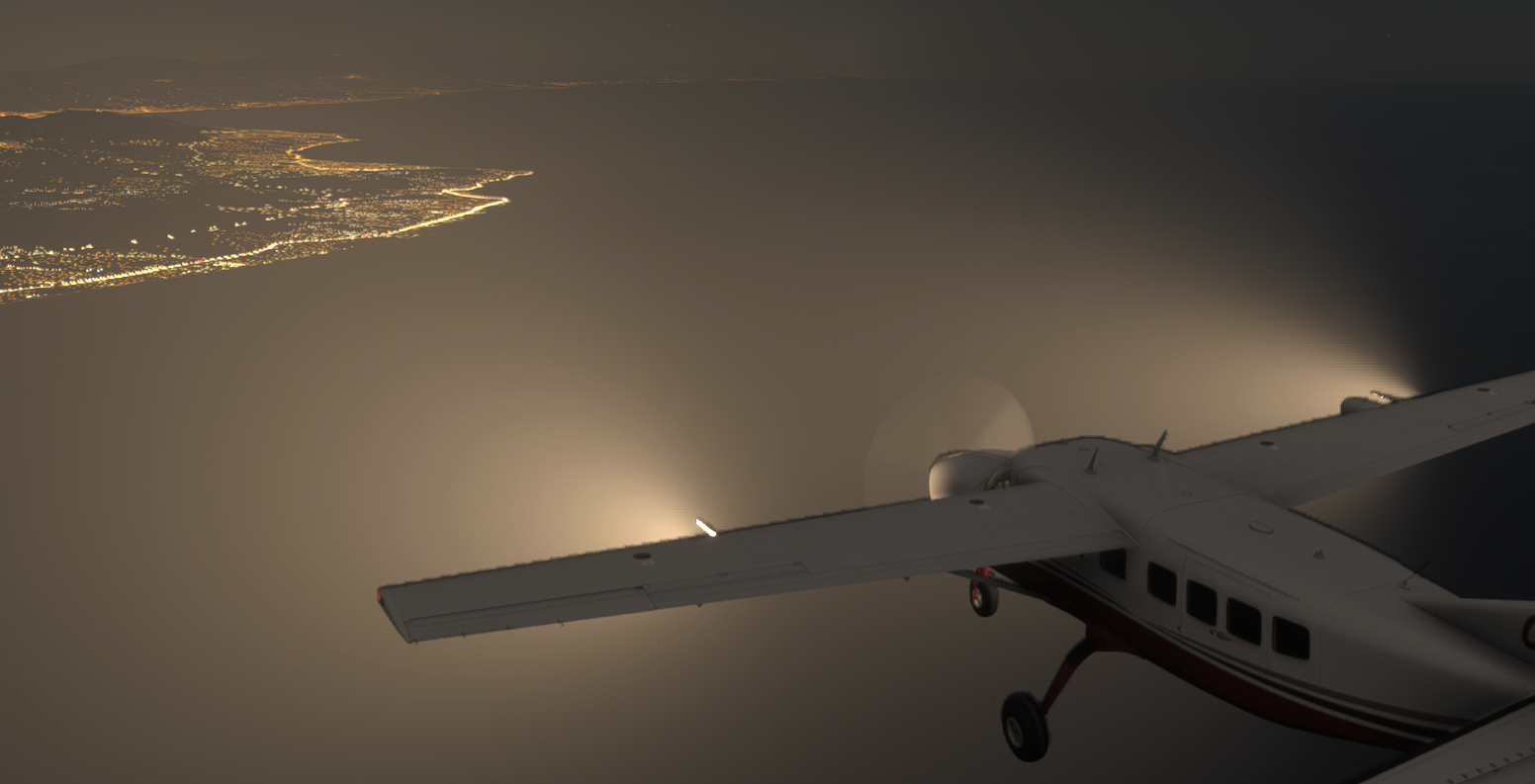
Also not really for this thread, but would like to hear from real world pilot. Are the lights at night really that blinding even in clear weather? I feel like they are fog generators on their own.
-
@asnamara Are these values highly ISA specific as I noted that if weather is like ISA +6, with this caravan you can only obtain lik 166kt at 8k ft, which seems really slow to me on no pod passenger model.
Also not really for this thread, but would like to hear from real world pilot. Are the lights at night really that blinding even in clear weather? I feel like they are fog generators on their own.
@Persojet without pulling out charts, 166kts with no pods at 8k sounds reasonable. Pod reduces performance by about 3 kts from what I understand.. Also we don't really deal in ISA, just OAT and Altitude.. ISA + 6 at 8k is around 5C?
The lights are actually pretty blinding with Landing Lights on, we usually keep Taxi/Recog only until the very late on the landing, and only switch the full Landing Lights on just before landing as it does helps with depth perception for touchdown. The landing lights also mess up your peripheral vision at night. -
@Persojet without pulling out charts, 166kts with no pods at 8k sounds reasonable. Pod reduces performance by about 3 kts from what I understand.. Also we don't really deal in ISA, just OAT and Altitude.. ISA + 6 at 8k is around 5C?
The lights are actually pretty blinding with Landing Lights on, we usually keep Taxi/Recog only until the very late on the landing, and only switch the full Landing Lights on just before landing as it does helps with depth perception for touchdown. The landing lights also mess up your peripheral vision at night. -
@asnamara I was trying to reach maximum cruise power, but couldn't even go over 1500 torq wihtout being ITT limited. If I reduced ISA manually to 0, I could reach the 182 kt at ITT limit and 1750 torq.
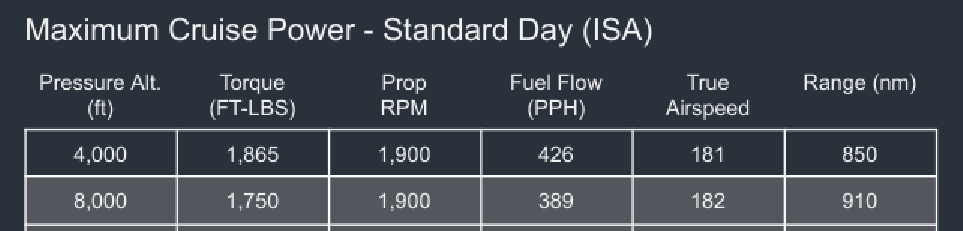
@Persojet yes it seems the torque vs ITT is not "okay" right now as per my original post above. You should in all normal circumstances at 8k be able to achieve Max Cruise Torque. Just looked at the chart anyways. On the podless caravan at 8k and 5C you should achieve about 172 kts. 166 is not far off.. so once you're able to achieve Max Torque it should bring you closer to that speed.
-
@asnamara I was trying to reach maximum cruise power, but couldn't even go over 1500 torq wihtout being ITT limited. If I reduced ISA manually to 0, I could reach the 182 kt at ITT limit and 1750 torq.
@Persojet also check that your fuel condition lever is in high idle. As having it in low idle will significantly affect your data in flight on this simulation. Whereas in real life, there is no difference in cruise between low and high idle. I believe @Black-Square Nick has that already fixed this issue in an upcoming update? Think I read that in one of the previous posts.
-
@Persojet also check that your fuel condition lever is in high idle. As having it in low idle will significantly affect your data in flight on this simulation. Whereas in real life, there is no difference in cruise between low and high idle. I believe @Black-Square Nick has that already fixed this issue in an upcoming update? Think I read that in one of the previous posts.
@asnamara said in Engine Model Accuracy:
@Persojet also check that your fuel condition lever is in high idle. As having it in low idle will significantly affect your data in flight on this simulation. Whereas in real life, there is no difference in cruise between low and high idle. I believe @Black-Square Nick has that already fixed this issue in an upcoming update? Think I read that in one of the previous posts.
I was in high idle. Maybe they'll patch the ITT and that allows to hit max cruise in normal flight like you say. Now it hinders the performance a lot when it's positive ISA.
-
@asnamara Are these values highly ISA specific as I noted that if weather is like ISA +6, with this caravan you can only obtain lik 166kt at 8k ft, which seems really slow to me on no pod passenger model.
Also not really for this thread, but would like to hear from real world pilot. Are the lights at night really that blinding even in clear weather? I feel like they are fog generators on their own.
@Persojet No. To my knowledge if you are not using HDR turning off Light Shafts in the Graphics settings fixes the issue. IRL you will see bloom like that only in visible moisture or hazy conditions (tho generally landing lights are also not as bright as they are in MSFS). HiFi have also vocalized issues with not being able to change the atmospheric density in MSFS2024... Very frustrating imo.
-
We have continued to beg Asobo for a fix to the light scattering in the developer forums, but there has been no engagement from Asobo since September of last year.
-
We have continued to beg Asobo for a fix to the light scattering in the developer forums, but there has been no engagement from Asobo since September of last year.
@Black-Square If I ever make a ton of money I'll buy my way into Asobo and start flipping over tables until it's fixed (amongst other more critical issues). For now we just have to be happy with what we have which begrudgingly is better than we've ever had before. It's almost more frustrating being so close to perfect and seeing no movement on issues that seem to pale in complexity when compared to everything else the sim can do.