Heating too weak?
-
@Black-Square Just wanted to add my thoughts on that. In the actual aircraft, the temperature typically stays quite a bit warmer than outside air temperature. As an example today, in the sim today, outside air temperature was 6 C, the interior temperature of the aircraft dropped to about 46 F, requiring Bleed Air Heat to warm the interior. On the real aircraft, 6 C OAT, you would be quite comfortable inside the aircraft, without requiring heat. There's heat generated by the engine up front, and during the day, the sun plays a significant factor in warming up the cabin. Not sure if that's modeled in MSFS though.
@asnamara said in Heating too weak?:
On the real aircraft, 6 C OAT, you would be quite comfortable inside the aircraft, without requiring heat. There's heat generated by the engine up front, and during the day, the sun plays a significant factor in warming up the cabin.
Can confirm the "greenhouse" effect from the windscreen - I'm in a temperate climate, and we rarely have to use the heat in winter thanks to the number of sunny days here. Up front, we're usually nice and warm with a jacket or light coat... Meanwhile, the pax in the back, "in the shade", are complaining of being cold. If I flew cargo, I guess I wouldn't have the complaints.

-
@asnamara Wow! May I ask whether you could suggest some nice routes and / or airports you know from IRL?
@heistema Hi there, I suggest you do flight's using freeware scenery from Vortex Scenery Designs. He makes excellent sceneries for the region, and they could suit "real-life flights". One example would be: FLMF-FWKI-FWUU-FWLK for a Zambia-Malawi flight... great Mozambique scenery as well...
-
I am just going to throw in a thought to defend Nick's "lack of greenhouse effect" modelling... the green house or radiant heat you feel through a window on an aircraft does not necessarily reflect the internal cabin temperature the probe reads or more precisely the actual temperature of the air flowing through the cabin. Theoretically the cabin temp probe could be reading 15C (59F) or lower with air flowing through and you could be feeling 25C-30C (77F-86F) from the sunlight beaming onto you and the surfaces around you. Radiant heat works by heating you and the surfaces around you first and then heating up the air by radiating off of you slowly. If there is continuous air flow, you still feel the heat and the air won't have time to heat up which will have the benefit of actively cooling you. So realistically you may want the cabin temp to read around 10-15C on a sunny day... Perhaps what all of you want is a "feels like" temperature. Lol
-
I am just going to throw in a thought to defend Nick's "lack of greenhouse effect" modelling... the green house or radiant heat you feel through a window on an aircraft does not necessarily reflect the internal cabin temperature the probe reads or more precisely the actual temperature of the air flowing through the cabin. Theoretically the cabin temp probe could be reading 15C (59F) or lower with air flowing through and you could be feeling 25C-30C (77F-86F) from the sunlight beaming onto you and the surfaces around you. Radiant heat works by heating you and the surfaces around you first and then heating up the air by radiating off of you slowly. If there is continuous air flow, you still feel the heat and the air won't have time to heat up which will have the benefit of actively cooling you. So realistically you may want the cabin temp to read around 10-15C on a sunny day... Perhaps what all of you want is a "feels like" temperature. Lol
@SadBucket I fully understand what you are saying, but I believe the internal temperature during cruise is usually about 15C higher in the cabin than OAT, without aircon/heat. Will take a couple of thermometers/temperature probes with me on the next trip and put them at different places in the cabin (cockpit, mid cabin and aft cabin). And compare with OAT, should be fun to do. OAT for most of those legs at cruise should be between 5 and 10 C.
-
@SadBucket I fully understand what you are saying, but I believe the internal temperature during cruise is usually about 15C higher in the cabin than OAT, without aircon/heat. Will take a couple of thermometers/temperature probes with me on the next trip and put them at different places in the cabin (cockpit, mid cabin and aft cabin). And compare with OAT, should be fun to do. OAT for most of those legs at cruise should be between 5 and 10 C.
-
@SadBucket I've taken a thermometer along on a couple of flights now. Without heating/air con/ventilation, in the cruise, the temperature during daytime is about 15 degrees higher in the cabin than it is outside.. both cockpit and row 3 (in the shade). Pretty consistently, 7 degrees OAT, 22 + degrees inside (FL120). These numbers seem consistent during longer legs. When flying shorter legs at lower altitudes, we leave the aircon on to be comfortable. Anyone with more data?
-
@SadBucket I've taken a thermometer along on a couple of flights now. Without heating/air con/ventilation, in the cruise, the temperature during daytime is about 15 degrees higher in the cabin than it is outside.. both cockpit and row 3 (in the shade). Pretty consistently, 7 degrees OAT, 22 + degrees inside (FL120). These numbers seem consistent during longer legs. When flying shorter legs at lower altitudes, we leave the aircon on to be comfortable. Anyone with more data?
-
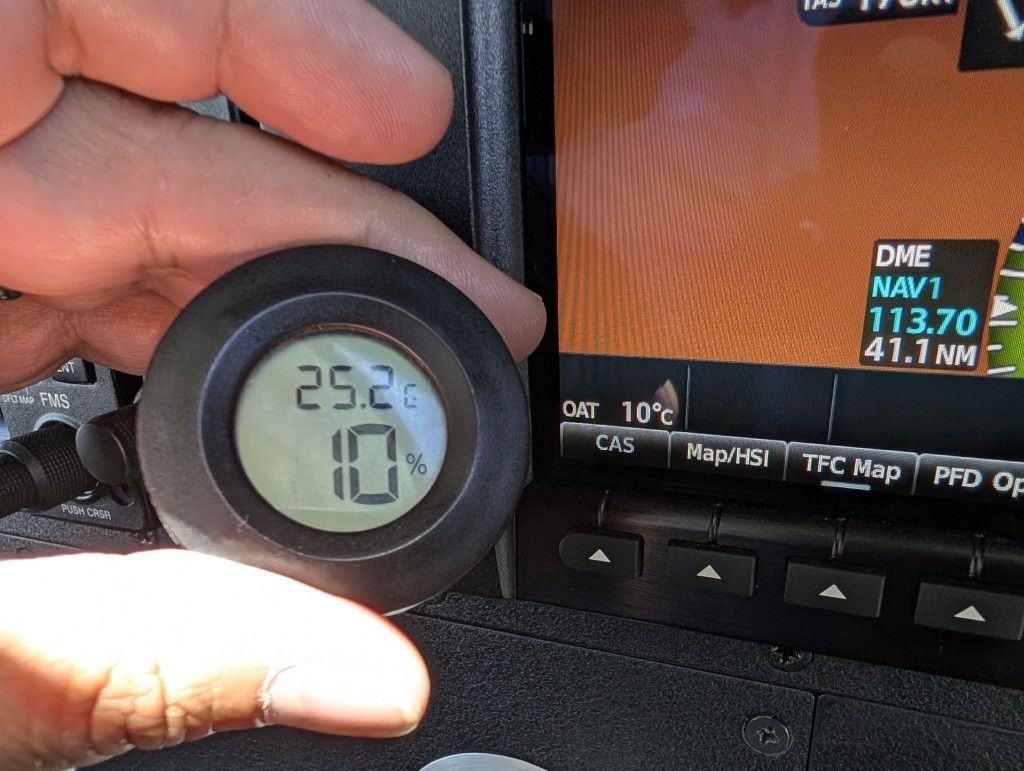
Here's an example. Thermometer settled mid-cabin in the shade for about an hour (FL100). 15 higher than OAT.
@asnamara I was thinking about this more and kind of expected it. Maybe we could see a better greenhouse effect modeled in the future. Not sure how difficult it would be to implement when factoring in whether you’re in shade or not. Sounds like more fun code that could be done with the logic behind a functional weather radar...
-
Are we not seeing that now? I was flying in Florida today with temperatures in the low 80s and the cabin would reach 100 on the ground if I didn't have any air conditioning.
-
@heistema Hi there, I suggest you do flight's using freeware scenery from Vortex Scenery Designs. He makes excellent sceneries for the region, and they could suit "real-life flights". One example would be: FLMF-FWKI-FWUU-FWLK for a Zambia-Malawi flight... great Mozambique scenery as well...
-
@jmarkows I think it's that the cabin shouldn't be cooling down as fast as it is, once airborne. There's residual heat, plus systems and passenger bodies that continue to contribute heat to the environment.
@C525B said in Heating too weak?:
@jmarkows I think it's that the cabin shouldn't be cooling down as fast as it is, once airborne. There's residual heat, plus systems and passenger bodies that continue to contribute heat to the environment.
I think I see what you mean now. In flight at 7000, OAT is about 10C, and all that solar heating effect on the ground seems to be gone.