F100 - ATS and Landing behaviour
-
Dear team, thank you for yet another amazing aircraft !!! Just wanted to confirm this issue on my side as well. Plane is very much struggling to keep speeds, both in speed by pitch modes and in speed by thrust modes.
-
I have a different issue, on disengaging the ATS, it randomly turns back on again on finals!
-
I have a different issue, on disengaging the ATS, it randomly turns back on again on finals!
-
I would like to chip in here with my modest observation - this might be an issue occurring only on MSFS 2024, imho.
I flew F100 in MSFS 2024, LOWW-EPKK, the turbulence settings set to low and nearly no wind, the plane climbed in profile mode, was unable to follow FMS selected IAS. Oscillations were always +/- 20 kts. The throttle was stable in climb thrust, but the plane was unable to follow the FD properly and was overshooting the selected speed until a cruise altitude was reached.
I flew F100 in MSFS 2020, the same route, the same conditions, the plane kept the speed in profile climb without any issues (tiny variations due to the wind, absolutely normal).
I also flew F70, only in MSFS2020 on LOWW-LZKZ-LOWW, different cruise altitudes and speeds, always flown accurately. Did not fly F70 in MSFS2024.
The ATS is sometimes slightly sluggish, but as Mark says, that is to be expected, and I did not find the ATS behaviour in MSFS 2020 particularly problematic (would say that 737s by a famous developer have a similarly sluggish auto throttle).
Could it be the difference between simulators?
-
@Damar_Rally The ATS will automatically engage to provide low speed protection if you decelerate into the amber VMA speed band.
@Martyn thank you for the information, but I am well above the amber band by 10kts when this happens.
-
I will have to finish reading the FCOM to verify this but in general, this is what happens when in a VNAV climb or Profile climb.
- The AT will set a climb thrust. This thrust will not vary during a climb, and it should not vary (altitude, temperature etc factors that affect engine performance aside).
- The AP will command a pitch in order to maintain the Profile speed. As you get higher, the pitch commanded will be lower until your reach cruise altitude.
- ALL A/T systems will seem sluggish. They are not designed to command extreme inputs. This could put an aircraft on a crazy roller coaster that no es bueno.
In other words, the FMC will determine the speed and then command a pitch to maintain that speed. Thrust should stay relatively the same until you reach cruise then cruise power is set.
Flying today, this is the exact behavior I saw. Yes, there were variations in pitch to maintain the speed, but it was always due to wind changes or local pressure changes. The AP compensated with pitch and my IAS did not get crazy.
Another point. Flight Directors do NOT actually command they direct. Pilots are taught to look through the flight directors and set attitude. If the FD directs pitch up and the pitch bar is on 30 degrees, do NOT pitch up 30 degrees nose up. Pitch up until the FD's settle down. You can get into crazy scenarios if you constantly try and chase the flight directors.
Guys/Gals, in the end automation is an assist for a pilot, not replacement. As a pilot you have to be able to do pilot crap at any time. If you find your automation not doing what you want it to do, fix it. I have had zero issues with the aircraft handling in any phase of flight. I will pay more attention on next flight and see if I can note something I am overlooking.
-
I will have to finish reading the FCOM to verify this but in general, this is what happens when in a VNAV climb or Profile climb.
- The AT will set a climb thrust. This thrust will not vary during a climb, and it should not vary (altitude, temperature etc factors that affect engine performance aside).
- The AP will command a pitch in order to maintain the Profile speed. As you get higher, the pitch commanded will be lower until your reach cruise altitude.
- ALL A/T systems will seem sluggish. They are not designed to command extreme inputs. This could put an aircraft on a crazy roller coaster that no es bueno.
In other words, the FMC will determine the speed and then command a pitch to maintain that speed. Thrust should stay relatively the same until you reach cruise then cruise power is set.
Flying today, this is the exact behavior I saw. Yes, there were variations in pitch to maintain the speed, but it was always due to wind changes or local pressure changes. The AP compensated with pitch and my IAS did not get crazy.
Another point. Flight Directors do NOT actually command they direct. Pilots are taught to look through the flight directors and set attitude. If the FD directs pitch up and the pitch bar is on 30 degrees, do NOT pitch up 30 degrees nose up. Pitch up until the FD's settle down. You can get into crazy scenarios if you constantly try and chase the flight directors.
Guys/Gals, in the end automation is an assist for a pilot, not replacement. As a pilot you have to be able to do pilot crap at any time. If you find your automation not doing what you want it to do, fix it. I have had zero issues with the aircraft handling in any phase of flight. I will pay more attention on next flight and see if I can note something I am overlooking.
Thanks for the refresher on VNAV and Flight Director operations, but I believe the main point of my report was missed.
I operate in virtual aviation with the exact same standards and rigor that I apply in the real-world aircraft I fly for a living.
I bring the same situational awareness and mindset to the sim as I would if the machine were real. I’m fully aware that automation is merely an assist and that reverting to manual flight (doing “””pilot crap”””) is the standard procedure when a system misbehaves.
The issue I am pointing out isn't a misinterpretation of the FD or a lack of understanding of basic autoflight logic. The problem is that the system responds aggressively and erratically in perfectly calm air. In a scenario with absolutely no variations in wind direction, wind speed, or local pressure, the system failing to manage basic pitch and power coordination is extremely strange. I am not looking for flawless automation to compensate for poor piloting technique, I am simply reporting an anomaly in the addon's flight control logic that behaves unrealistically in neutral atmospheric conditions.
-
I will have to finish reading the FCOM to verify this but in general, this is what happens when in a VNAV climb or Profile climb.
- The AT will set a climb thrust. This thrust will not vary during a climb, and it should not vary (altitude, temperature etc factors that affect engine performance aside).
- The AP will command a pitch in order to maintain the Profile speed. As you get higher, the pitch commanded will be lower until your reach cruise altitude.
- ALL A/T systems will seem sluggish. They are not designed to command extreme inputs. This could put an aircraft on a crazy roller coaster that no es bueno.
In other words, the FMC will determine the speed and then command a pitch to maintain that speed. Thrust should stay relatively the same until you reach cruise then cruise power is set.
Flying today, this is the exact behavior I saw. Yes, there were variations in pitch to maintain the speed, but it was always due to wind changes or local pressure changes. The AP compensated with pitch and my IAS did not get crazy.
Another point. Flight Directors do NOT actually command they direct. Pilots are taught to look through the flight directors and set attitude. If the FD directs pitch up and the pitch bar is on 30 degrees, do NOT pitch up 30 degrees nose up. Pitch up until the FD's settle down. You can get into crazy scenarios if you constantly try and chase the flight directors.
Guys/Gals, in the end automation is an assist for a pilot, not replacement. As a pilot you have to be able to do pilot crap at any time. If you find your automation not doing what you want it to do, fix it. I have had zero issues with the aircraft handling in any phase of flight. I will pay more attention on next flight and see if I can note something I am overlooking.
@Crabby A/T seems sluggish, but I don't think it's supposed to allow the speed to drop by as much as 30 knots below the selected value, leading to speeds even below VMA.
And then, according to the manuals:
ATS is supposed to be used in all flight modes, all the way to landing.As the manuals says:
"ATS during Landing
During landing, automatic thrust lever retardation to idle occurs below 50 ft AGL.
The FMA will show RET in the thrust window."And also:
"AUTOMATIC GUST CORRECTION
During approach in gusty wind conditions, ATS will control to a speed not below VMA +8. VMA and VSEL at the PFD are not affected."So, Guys and Gals, these passages give me reason to believe that, as sluggish as the AT may be, it shouldn't be that imprecise....
-
Thanks for the refresher on VNAV and Flight Director operations, but I believe the main point of my report was missed.
I operate in virtual aviation with the exact same standards and rigor that I apply in the real-world aircraft I fly for a living.
I bring the same situational awareness and mindset to the sim as I would if the machine were real. I’m fully aware that automation is merely an assist and that reverting to manual flight (doing “””pilot crap”””) is the standard procedure when a system misbehaves.
The issue I am pointing out isn't a misinterpretation of the FD or a lack of understanding of basic autoflight logic. The problem is that the system responds aggressively and erratically in perfectly calm air. In a scenario with absolutely no variations in wind direction, wind speed, or local pressure, the system failing to manage basic pitch and power coordination is extremely strange. I am not looking for flawless automation to compensate for poor piloting technique, I am simply reporting an anomaly in the addon's flight control logic that behaves unrealistically in neutral atmospheric conditions.
-
@Crabby A/T seems sluggish, but I don't think it's supposed to allow the speed to drop by as much as 30 knots below the selected value, leading to speeds even below VMA.
And then, according to the manuals:
ATS is supposed to be used in all flight modes, all the way to landing.As the manuals says:
"ATS during Landing
During landing, automatic thrust lever retardation to idle occurs below 50 ft AGL.
The FMA will show RET in the thrust window."And also:
"AUTOMATIC GUST CORRECTION
During approach in gusty wind conditions, ATS will control to a speed not below VMA +8. VMA and VSEL at the PFD are not affected."So, Guys and Gals, these passages give me reason to believe that, as sluggish as the AT may be, it shouldn't be that imprecise....
@pedropolak I am still not through with the actual FCOM, however, straight from the US Airways FCOM:
LANDING
Except for autoland approaches, switch off the ATS at 50 feet or above.
Start to initiate a flare at approximately 30 feet for a manual landing.
For autoland approaches, monitor the thrust lever movement to idle. For all
other approaches, retard the thrust levers manually back to idle. After an
autoland, the autopilot has to be switched off before 60 knots.Just got done scanning the Alliance FCOM and it reads the same. I understand the manuals provided may say different (I have not read them past recommended settings. I have various FCOMs and that is what I learn on), however there is no FCOM recommendation to use the ATS from start to finish.
Granted, there could be another operator SOP that says ATS is to always be used. I know that is the case for the 777. I just can't find reference to that in real documents.
-
I experience the same. Using MSFS 2024. The aircraft struggles to maintain speed, the autopilot seems to be too slow in response, resulting in unrealistic large pitch oscillations and large thrust corrections. It would be nice if JF could tweak this behaviour and make the autopilot more responsive.
-
Wanted to step in here too to report a surprisingly large variation of speeds during an approach in calm weather conditions.
Approach speed varies in a range of like 20 to 30kt when handled by ATS and I've found it to be super super difficult to manage energy on approach an landing.
I've done three flights so far and every APP was messed up to an extent that I should have gone around.
Been flying various sims and different aircraft (yep, Boeing and Airbus) for 20 years now and always been able to quickly get used to new environment. Sure, a part of my bad approaches are due to differences between Fokker and A/B which I just have to get used to but it feels like some parameters of the addon could use a little fine tuning too. -
I'm not sure it's all the ATS' and A/P's fault. I'm not sure how it's calculated in the real aircraft, but I've seen that the speed trend indication is very very responsive, much more so than in any other aircraft I've flown. I usually never use ATS on final (in any plane), but I've basically having to force myself to disregard the speed trend indication or I would end up doing some very excessive and unnecessary throttle changes myself (something that did happen for the first half of my first approach, before I noticed).
Also, even though it's slightly off topic, since someone mentioned FLCH, if you fly manually and have the F/D vertical mode in FLCH you'll see that the flight director has a similar problem, the commands are very large and vary very quickly. Maybe this can throw off the A/P and ATS?
Next flight I do I'll try to get some footage of both of these things.
-
Is there any fix for the "nose down at ap disconnect" and massive trim up needed on the horizon?
-
Is there any fix for the "nose down at ap disconnect" and massive trim up needed on the horizon?
@storemaster For a moment I thoguht Flaps 25 instead of 40 was a way around, but talking to friend that looked like just a coincidence.
-
Had a vAPP of 121kn today and I didn't manage to perform a stable approach.
Aircraft accelerated to 160kn and even higher as you can see on this screenshot (wasn't able to record a video quickly enough):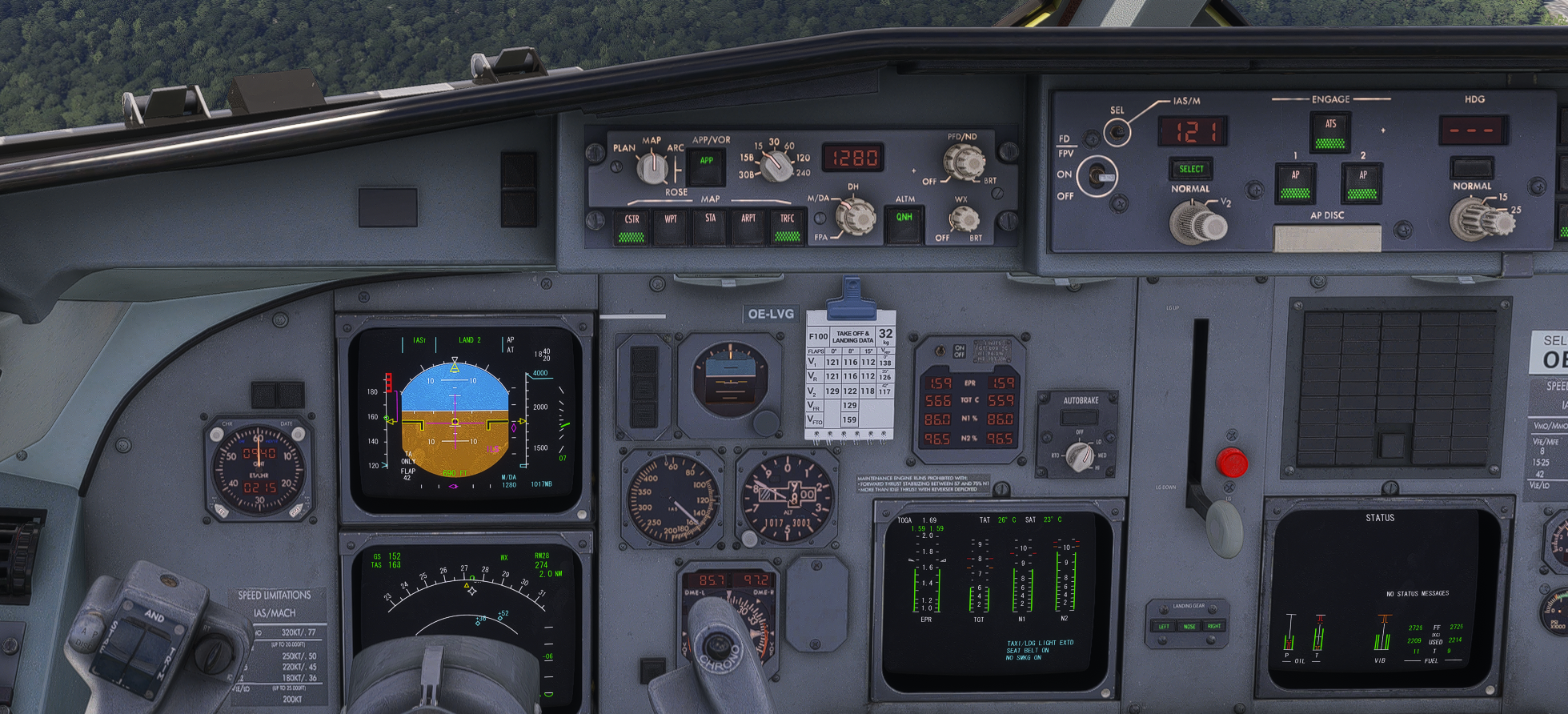
@OELVA Second this. I had erratic speed changes up to 160kts, all the way from 121kts which was selected.
-
I would like to chip in here with my modest observation - this might be an issue occurring only on MSFS 2024, imho.
I flew F100 in MSFS 2024, LOWW-EPKK, the turbulence settings set to low and nearly no wind, the plane climbed in profile mode, was unable to follow FMS selected IAS. Oscillations were always +/- 20 kts. The throttle was stable in climb thrust, but the plane was unable to follow the FD properly and was overshooting the selected speed until a cruise altitude was reached.
I flew F100 in MSFS 2020, the same route, the same conditions, the plane kept the speed in profile climb without any issues (tiny variations due to the wind, absolutely normal).
I also flew F70, only in MSFS2020 on LOWW-LZKZ-LOWW, different cruise altitudes and speeds, always flown accurately. Did not fly F70 in MSFS2024.
The ATS is sometimes slightly sluggish, but as Mark says, that is to be expected, and I did not find the ATS behaviour in MSFS 2020 particularly problematic (would say that 737s by a famous developer have a similarly sluggish auto throttle).
Could it be the difference between simulators?
@MichailusB
Can anyone else who uses MSFS 2020 confirm this? I use MSFS 2024 and the plane can't maintain speed on climb ( even on descent in LVL change mode it oscillates a lot ). If this is a case of only in MSFS 2024 issue then it needs to be investigated. -
Hi all!
I had huge problems flying the f100/f70 in real weather. Approach speeds fluctuating wildly and incontrollable aircraft. But, I found a solution in the internet which seems to work on my pc. It’s a windows problem (!). The OS clock synchronization, didn’t work well (but check also DNS and IPv6). It caused MSFS2024 to mess up winds, particularly during last 500 feet AGL of the approach.
The link is here:
https://forums.flightsimulator.com/t/extreme-crosswinds-and-wind-swings-close-to-the-ground-on-final/728054Many thanks to paulofranca89!