
Nose up and down
-
It looks like for the majority of that video, the aircraft is below VFTO speed with Flap 0 and stalling.
With the autopilot engaged, but with no vertical modes selected on MCP, the aircraft remains in basic PITCH mode and retains the initial pitch angle at the time of engagement. In PITCH mode, the pitch can be adjusted either via the PITCH control on the autopilot controller on the aft pedestal or via the autopilot SYNC function.
In the video, there are instances where the autopilot is engaged with a pitch angle of 15 degrees, which is rather excessive for the aircraft when at high weights and with one engine at idle.
When a stall is sensed, the aircraft's protections start kicking in, which include the autopilot disconnect, stick shaker and stick pusher, which can be seen in the video.
If you're new to the 146, the aircraft is quite a quirky in how it operates compared to more modern aircraft, so we'd recommend having a run through of the tutorial flight from page 182 of the 146 Professional Operations Manual: https://support.justflight.com/en/support/solutions/articles/17000134438-146-professional-msfs-manuals
We also have tutorial videos on our YouTube channel covering the tutorial flight: https://youtu.be/bFV_Zg86h-k?si=IL1hLqzLk3uBwdbs
Mark - Just Flight
-
to be honest, i dont understand what i doing wrong this happend always https://youtu.be/FLKLAnUZhco
@just737 Need to start your videos earlier!
At the very beginning of your video you are already at FL290 at 15 degrees nose up in a 30 degree bank climbing at 2500 fpm! You can also see, that your trim is far nose up and moving further. This is not a situation you should get yourself into in the first place, so that is the real issue to solve first. You are 20 kts below VFTO and in a full bank so this is never ending well.
Unsurprisingly 5 seconds in, the stick shaker/pusher activates as you are entering a stall.

You should not use the autopilot to try and recover in a stalled condition. You need to fly the plane! Get the nose down first and your speed back up before you even consider looking at the autopilot again.
The reason it drops and rises at this point is that you are constantly going into a stall, only to have the automation push down your nose. But your trim is so far back, that soon after the pusher stops, your nose is again pointing way high --> you slow down and end in a stall again.Minimum manoeuvring speed at flaps 0 is VFTO + 15 KIAS (182+15= 197 kts in your case). Don't go below that speed if you are going to make any turns.
Looks like you are in "mach" mode on the AP in the beginning. Don't go into that immediately on initial climb. Use IAS until you are already up much higher in your climb, where your IAS matches Mach 0.6. -
@just737 Need to start your videos earlier!
At the very beginning of your video you are already at FL290 at 15 degrees nose up in a 30 degree bank climbing at 2500 fpm! You can also see, that your trim is far nose up and moving further. This is not a situation you should get yourself into in the first place, so that is the real issue to solve first. You are 20 kts below VFTO and in a full bank so this is never ending well.
Unsurprisingly 5 seconds in, the stick shaker/pusher activates as you are entering a stall.
You should not use the autopilot to try and recover in a stalled condition. You need to fly the plane! Get the nose down first and your speed back up before you even consider looking at the autopilot again.
The reason it drops and rises at this point is that you are constantly going into a stall, only to have the automation push down your nose. But your trim is so far back, that soon after the pusher stops, your nose is again pointing way high --> you slow down and end in a stall again.Minimum manoeuvring speed at flaps 0 is VFTO + 15 KIAS (182+15= 197 kts in your case). Don't go below that speed if you are going to make any turns.
Looks like you are in "mach" mode on the AP in the beginning. Don't go into that immediately on initial climb. Use IAS until you are already up much higher in your climb, where your IAS matches Mach 0.6. -
@just737 Yes - that is fine and I didn't write anything to say that your flaps setting was wrong.
After takeoff you accelerate, and once you have reached VFTO (182 kts as showed on the paper in your video) the FO will say "VFTO - safe flightspeed - select flaps up" and you can go flaps up/0. After this you should not let your indicated airspeed drop below VFTO again without flaps.
-
@just737 Yes - that is fine and I didn't write anything to say that your flaps setting was wrong.
After takeoff you accelerate, and once you have reached VFTO (182 kts as showed on the paper in your video) the FO will say "VFTO - safe flightspeed - select flaps up" and you can go flaps up/0. After this you should not let your indicated airspeed drop below VFTO again without flaps.
-
Yes it is a speed.
I again suggest you perhaps go back and watch the tutorial videos or check out the nicely detailed manual for the 146.
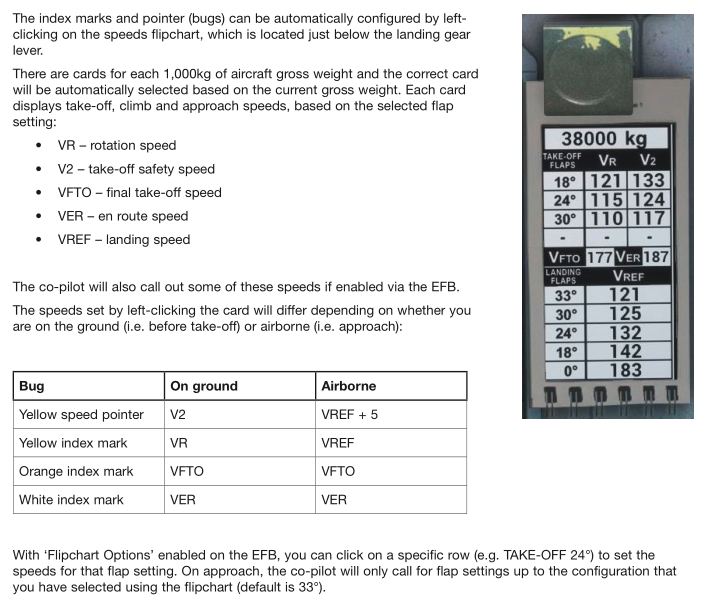
Also described the tutorial flight in the manual.
Also described in the video tutorials already linked to you previously in this thread.So if you use the clickspot to set the speed bugs as described - don't go slower than the highest speed bug when on your climb - and certainly not the below the orange indicating VFTO. In your video the flipchart shows VFTO = 182 kts and you are down near 160 kts.


 but it’s nice aircraft anyway.